
Sensfix Applied AI Blueprint
Applied AI Blueprint: Airport Facility Operations
How Proven Multimodal AI Capabilities Address 17 Airport Maintenance & Operations Domains
The $4.2 Billion AI Opportunity in Airport Operations
The global AI in aviation market is projected to reach $4.2 billion by 2030 (MarketsandMarkets 2025). Airports that have already moved — Seattle-Tacoma, Heathrow, Schiphol, Changi, Minneapolis-St. Paul — report 25% departure delay reductions through AI turnaround management, 50%+ maintenance cost cuts through unified building management systems, and 79% bird strike reductions through AI-integrated wildlife monitoring. Each of these airports used 5-8 different vendors to achieve these results. The question for airports that haven't yet deployed is not whether to adopt AI — it's how to avoid building a fragmented 8-vendor technology stack that creates as many integration problems as it solves.
The urgency is compounding. Hurricane vulnerability exposed electrical vaults as critical single points of failure — Hurricanes Helene and Milton in 2024 caused $10M+ in emergency rehabilitation at exposed airports. Aging infrastructure demands simultaneous attention: fire alarm systems, cooling towers, emergency generators, and parking structures are all reaching end-of-life within the same planning horizon. Annual global costs of bird strikes ($10 billion, FAA/ICAO) and foreign object debris damage ($13 billion, FAA) represent preventable losses that proven AI systems have already demonstrated the ability to reduce.
Sensfix is already operating in the Tampa Bay region — monitoring crane operations at the Port of Tampa with a production-proven <1% error rate. The SAAI platform is the only system unifying computer vision, audio AI, IoT, and workflow automation in a single suite. 42+ proprietary AI models have been trained across industrial facilities on 3 continents. The technology is funded by a €2.5M EU R&D Grant and validated through a Stanford University collaboration with the Department of Computer Science, Robotics Laboratory. This Blueprint documents how every one of those proven capabilities maps to a specific airport operations domain.
$4.2B
AI in aviation market by 2030
25%
Delay reduction with AI turnaround mgmt
50%+
Maintenance cost cut at MSP Airport
79%
Bird strike reduction at Aalborg
$13B
Annual global FOD damage cost
820+
Airports using AI bird detection
HVAC & Mechanical Predictive Maintenance
The Problem
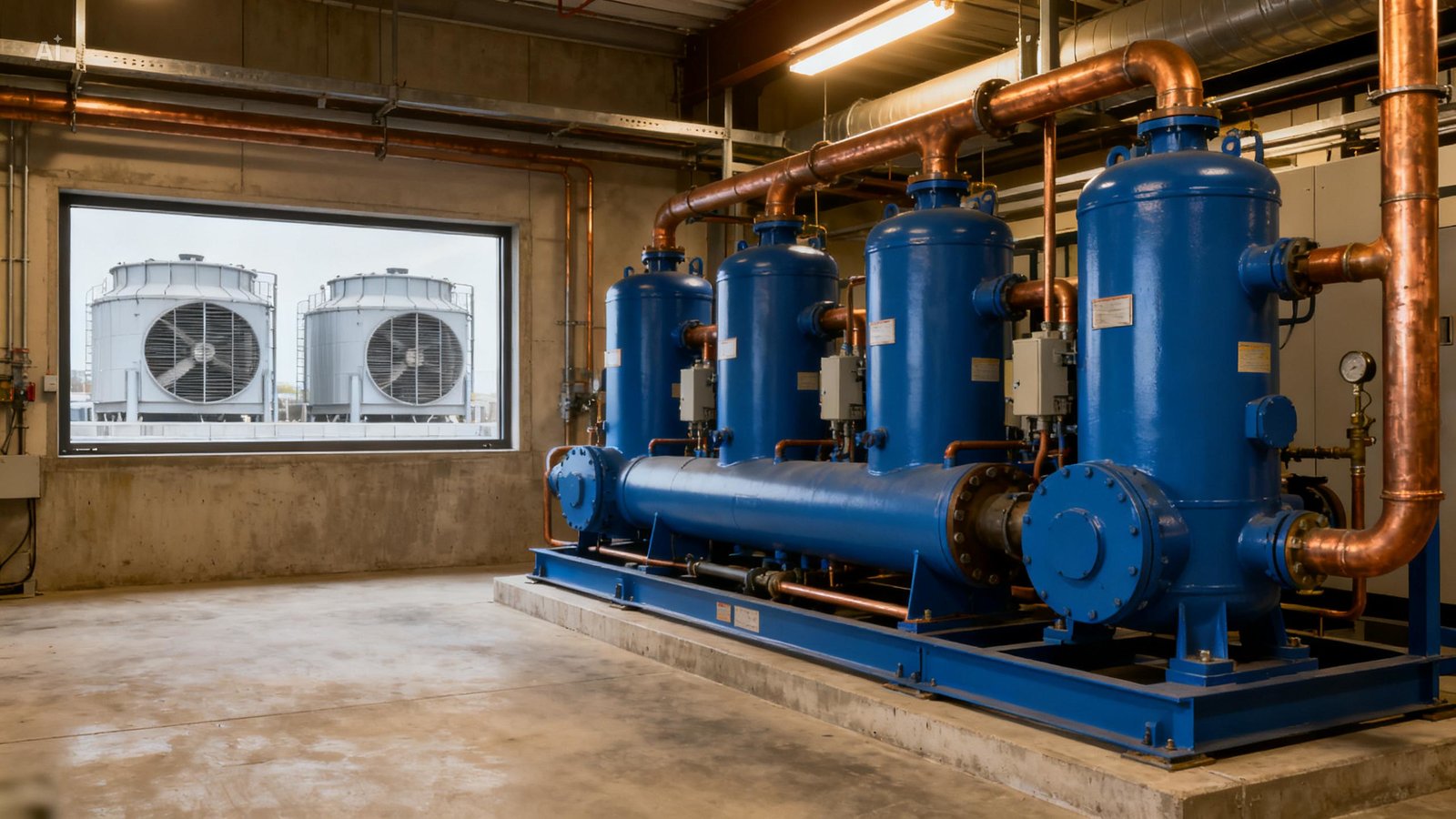
Airport terminals run HVAC systems 24/7/365. A chiller failure during peak summer season means 50,000+ passengers in a terminal with no cooling. Cooling tower gearboxes, fan motors, chiller compressors, and actuators degrade under constant load — but maintenance is calendar-based: service every X months regardless of actual equipment condition.
Reclaimed water corrosion accelerates failures beyond expected maintenance cycles. One major US airport found gearboxes, actuators, fan blades, and electrical conduits all failing prematurely because corrosion rates outpaced the scheduled inspection frequency. Between scheduled maintenance visits, equipment condition is unknown. A bearing that started vibrating abnormally on Tuesday won't be discovered until the next service window — which might be three weeks away.
What Leading Airports Report
| Airport | Scope | Result |
|---|---|---|
| Minneapolis-St. Paul (39M pax/yr) | Unified BMS across 90+ buildings, 3M sq ft | 50%+ maintenance cost reduction, payback under 4 years |
| Amsterdam Schiphol | Digital twin + 80,000 IoT sensors | 15% maintenance cost reduction, 30% unplanned downtime reduction |
| Singapore Changi | IoT predictive maintenance program | 15% equipment downtime reduction by 2021 |
How Sensfix Approaches This Differently
The systems at Minneapolis-St. Paul and Schiphol required multi-year, multi-million-dollar BMS overhauls with proprietary hardware ecosystems. Each deployment cost $5M+ and took 2-3 years to fully implement.
Sensfix achieves predictive maintenance through existing cameras and smartphones — no sensor retrofit required. Audio AI compares real-time equipment sounds against factory-reference recordings to detect compressor degradation, bearing wear, and motor imbalance before physical symptoms appear. This is proven on rotating machinery at the world's second-largest train manufacturer, where compressor air leakage is detected from sound anomalies alone. The same technology applies directly to cooling tower gearboxes, chiller compressors, and fan motors.
ServiceScanAI adds visual corrosion detection on cooling towers, pipe connections, and condenser coils — catching the degradation that accelerates failure between service windows. ServiceOCRPro automates gauge reading rounds — technicians point their phone at any temperature gauge, pressure dial, or digital display and the AI reads, records, and trends the value automatically.
The result: continuous equipment health intelligence from day one, using infrastructure the airport already has, at a fraction of the cost of a BMS overhaul.
Fire Alarm Inspection Digitization
The Problem
Fire safety compliance is non-negotiable — NFPA 72 mandates regular inspection, testing, and maintenance of fire alarm systems, sprinklers, extinguishers, emergency lighting, and exit signage across every airport building. A typical airport campus spans 5+ airsides, multiple parking structures, and dozens of peripheral facilities — each with hundreds of devices that must be inspected on defined schedules.
When original equipment vendors discontinue legacy components, airports face multi-year, multi-million-dollar replacement programs. Once new equipment is installed, ongoing NFPA 72 inspection across the entire campus must still be managed — typically via paper forms that are error-prone, difficult to audit, and impossible to analyze for trends.
Peer Airport Benchmarks
| Airport | Scope | Result |
|---|---|---|
| Phoenix Sky Harbor T4 (94K daily pax) | Digital dashboards + mobile barcode-scanning inspection | AHJs and OSHA officials "amazed at the level of detailed information" |
| Industry benchmark | AI-powered inspection assistant platforms (15K+ professionals, 10M+ devices) | 33 hours/month saved per technician, 15-20 min/report reduction |
| Mactan-Cebu International (12M pax/yr) | 400 new detectors with centralized graphical monitoring | Modular, expandable digital fire detection |
Why One Platform Beats Dedicated Fire Inspection Software
Standalone fire inspection digitization tools solve one problem. Sensfix's TaskflowDigitizerAI digitizes any maintenance workflow — fire alarm inspections today, HVAC rounds tomorrow, storm prep checklists next week — all under the same platform technicians already know. This eliminates the "one app per task" proliferation that frustrates field teams and inflates IT support costs.
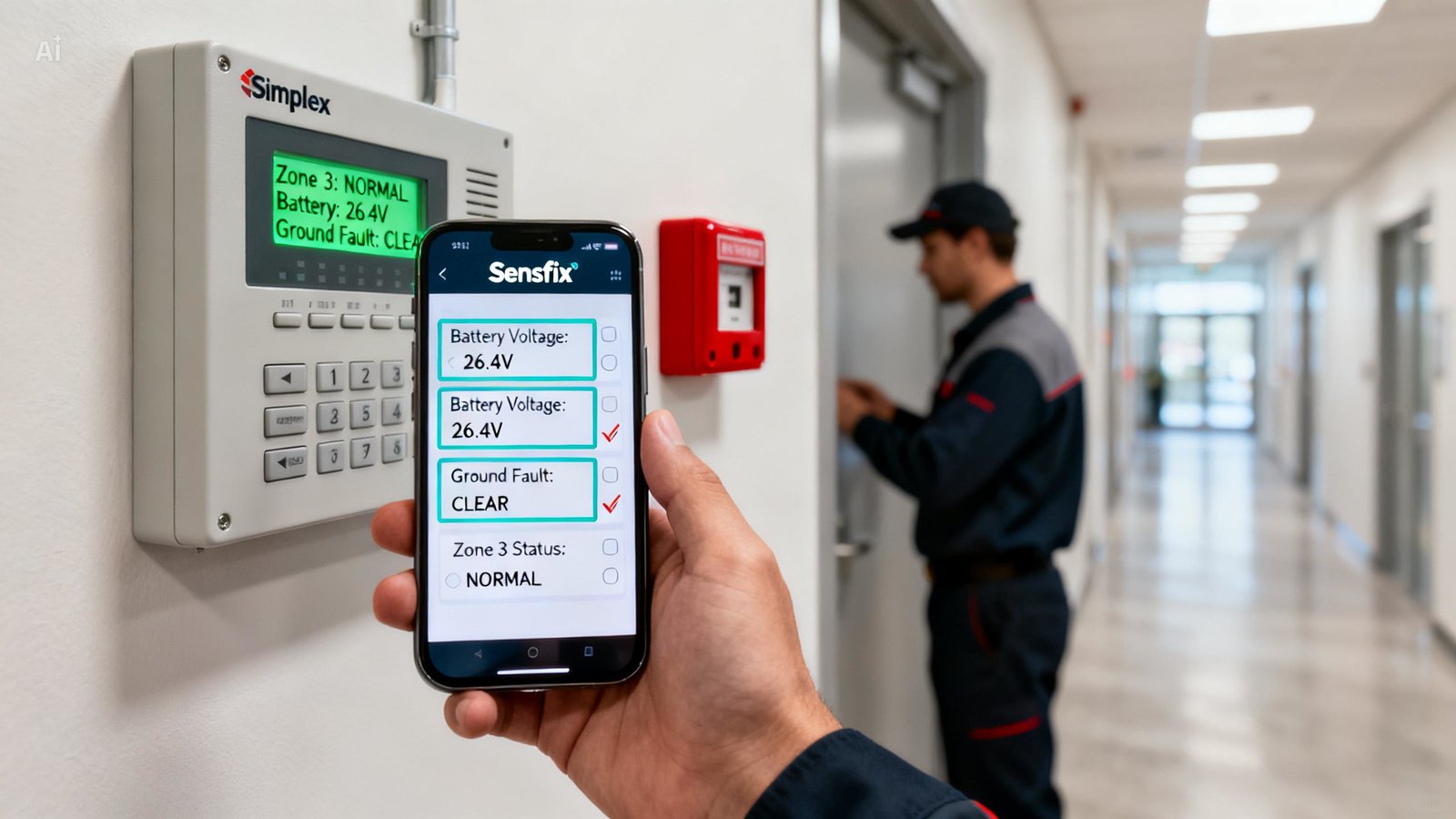
ServiceOCRPro reads fire alarm panel displays automatically during inspection rounds — zone status, battery voltage, ground fault indicators — extracting readings instantly and comparing against compliance thresholds. FormifyPro provides pre-loaded NFPA 72 Table 14.3.1 templates so inspectors follow the exact regulatory sequence with mandatory photo evidence at each step.
Phoenix Sky Harbor's parallel journey — same scale, same challenge, same era of original installation — validates the approach. Their digital dashboard transformed how inspectors, AHJs, and OSHA officials interact with fire safety compliance data.
Parking Garage Structural Inspection
The Problem
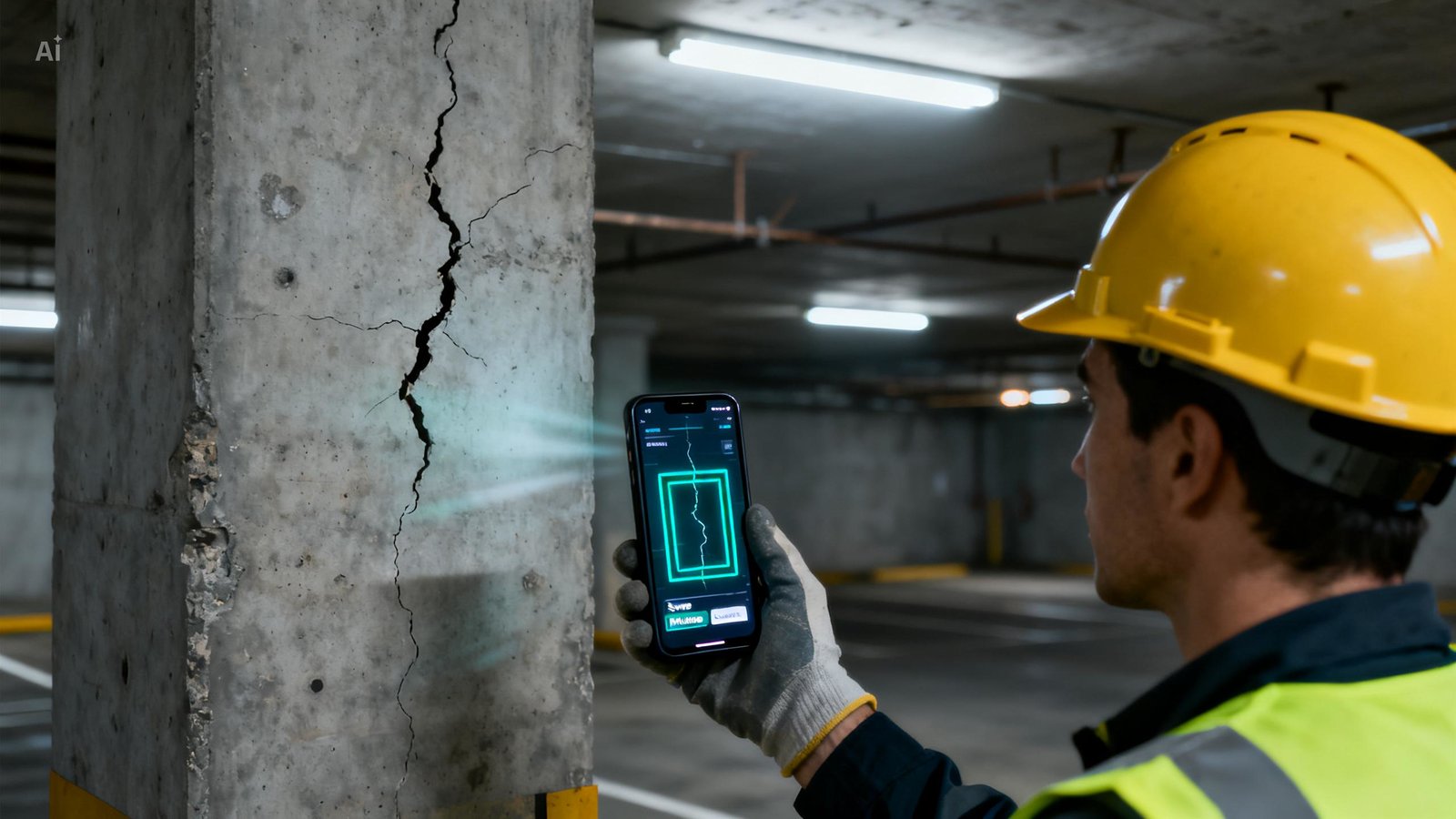
Airport parking structures endure extreme loads — thousands of vehicles daily, constant water exposure from rain and washing, de-icing chemical infiltration in winter climates, and structural vibration from adjacent airfield operations. Concrete deterioration — cracking, spalling, exposed rebar, and expansion joint failure — progresses invisibly between scheduled engineering inspections, which may occur quarterly or annually.
The consequences of missed deterioration are not hypothetical. The 2021 Surfside condominium collapse in Florida — 45 miles from Tampa — killed 98 people after cracks noted years earlier went untracked. For airports managing $10M+ in active parking garage rehabilitation, continuous monitoring is not a luxury; it's a structural safety imperative.
Where This Technology Is Proven
| Deployment | Scope | Result |
|---|---|---|
| Dübendorf Air Base, Switzerland | Drone imagery with AI vision transformer trained on 200K+ concrete images | 94% accuracy in crack classification |
| 3 US airport sites | AI/ML pavement crack detection | 75% field time reduction, 99% CAD digitization reduction, $144K savings per 100 inspections |
| Japan NEXCO expressway (16,700 bridges) | AI-powered infrastructure inspection | Crack, peeling, rebar detection matching expert inspectors |
| Pittsburgh International Airport $1.7B modernization | Robotic structural inspection during construction | ~99% asset coverage vs. 3-5% manual |
The Sensfix Advantage
The deployments above used specialized inspection robots, drones, or dedicated hardware systems costing $200K+ per deployment. Sensfix achieves concrete defect detection through standard smartphone cameras — the devices inspection teams already carry. 42+ proprietary defect models, trained across industrial facilities on 3 continents, detect cracks, spalling, exposed rebar, corrosion, and delamination at resolutions as fine as 0.2mm.
The Multimodal Rule Engine adds intelligence to raw detections: "If crack width exceeds 5mm, escalate to structural engineer and create priority work order." FormifyPro provides digital condition assessment forms that replace paper-based inspection sheets with photo-tagged, GPS-located records.
No airport has published a formal AI parking garage inspection case study. The opportunity to establish the first national reference case — much as Seattle-Tacoma became the reference for avian radar in 2007 — remains open.
Wildlife Management & Bird Strike Prevention
The Problem
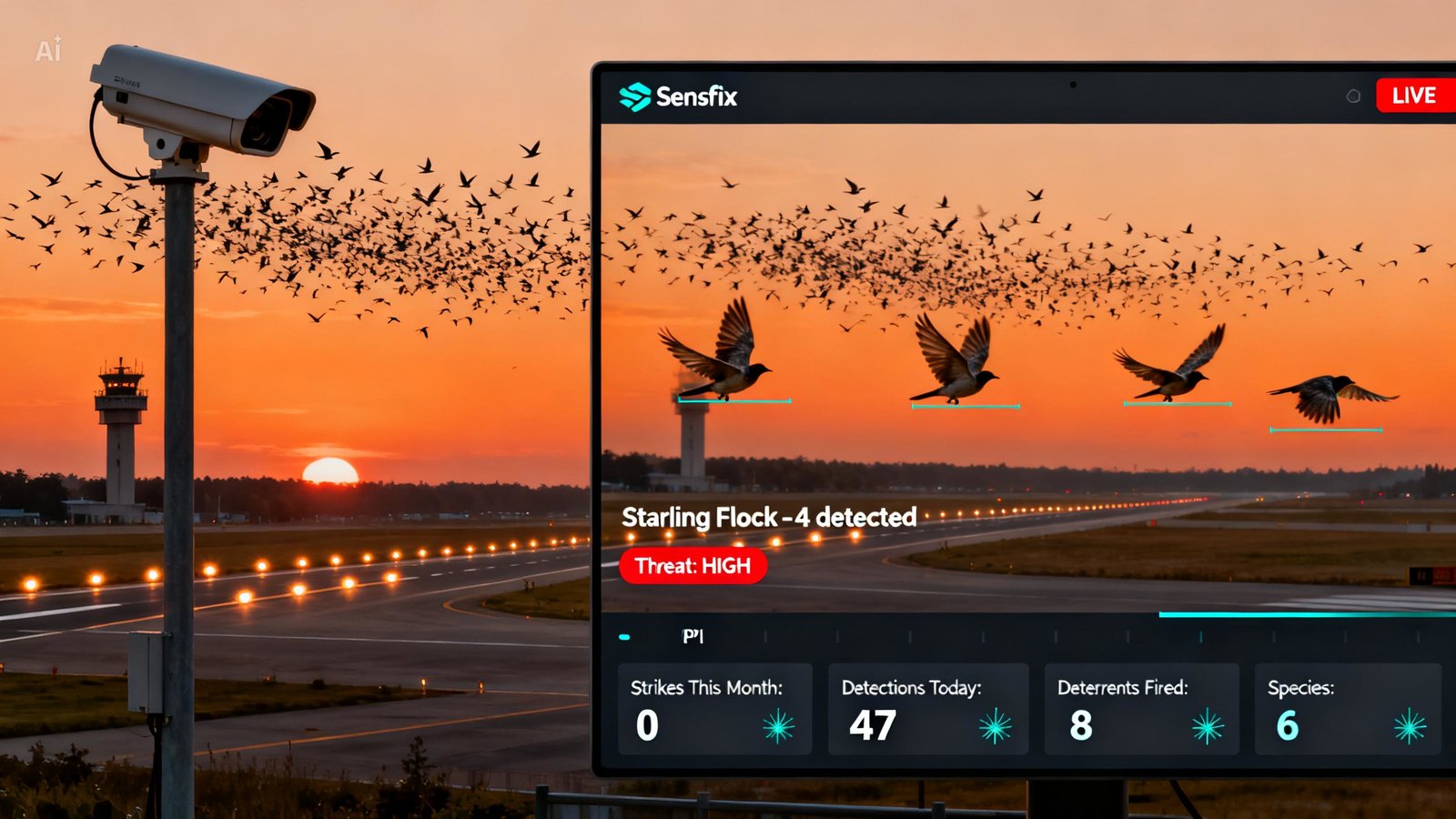
Bird strikes cost global aviation $10 billion annually. The FAA recorded 22,372 wildlife strikes in 2024 alone. Airports must comply with FAA 14 CFR §139.337, which requires wildlife hazard management programs including species identification, habitat assessment, and active deterrence.
Manual patrols — biologists driving the airfield perimeter — cannot provide 24/7 species-specific monitoring. A patrol that checks the runway approach zone at 8 AM misses the starling flock that settled at 8:15. Environmental programs that remove habitat and relocate protected species (such as gopher tortoises) create wildlife transition zones that require continuous monitoring during the adjustment period.
Named Deployments with Results
| Airport | Scope | Result |
|---|---|---|
| Aalborg, Denmark | AI-integrated holistic wildlife management | 79% bird strike reduction (16.8→3.5 per 10,000 movements); 50% reduction in year one |
| Amsterdam Schiphol (all 6 runways) | 3D radar with 360° coverage to 10km + IoT deterrence | Real-time tracking integrated with automated deterrence |
| Berlin Brandenburg | Radar + IoT-connected acoustic deterrence | Controllers activate gas cannons remotely from tablets |
| Seattle-Tacoma | Avian radar | World's first civil airport with real-time bird tracking (2010) |
| RAF Lossiemouth, Scotland | AI bird detection radar | £1.4M 5-year contract; reduced operational restrictions during peak bird activity |
What Makes the SAAI Platform Different for Wildlife
Dedicated avian radar systems cost $200K-$500K per installation and address only one use case: bird detection. Sensfix's computer vision detects and classifies bird species using existing CCTV cameras already deployed across airport perimeters — at a fraction of the hardware cost.
More importantly, the same platform that monitors birds also monitors construction progress, parking structure condition, and equipment health. One investment, seventeen applications. Dedicated radar vendors deliver one.
Audio AI adds a second dimension — species-specific distress calls can be triggered by visual identification, creating an integrated detect-and-deter loop from a single platform. Over 820 airports globally have already adopted AI bird detection. The technology is proven; the question is which platform delivers the most value per dollar invested.
Baggage Handling System Predictive Maintenance
The Problem
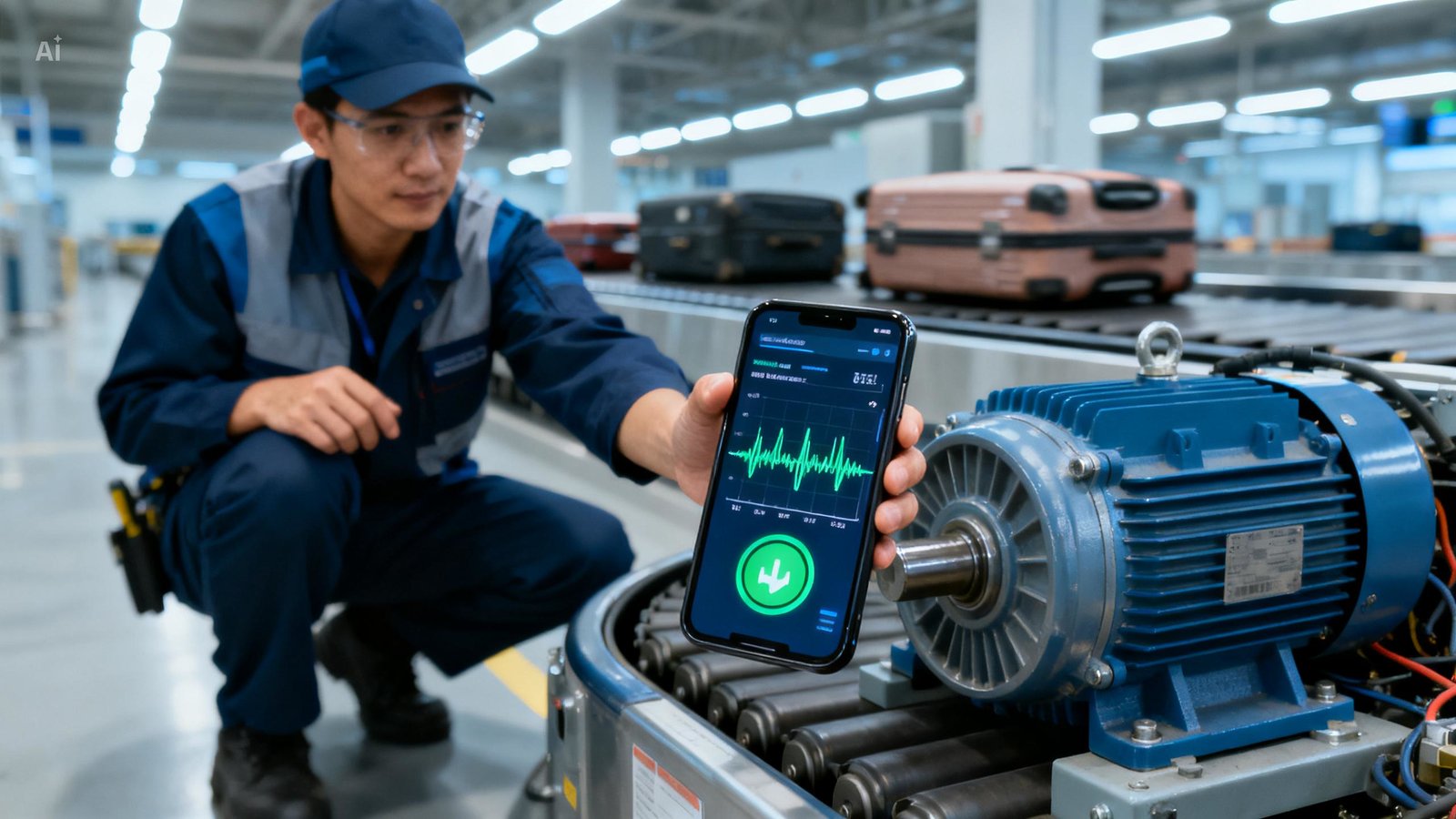
Baggage handling systems are the circulatory system of any airport terminal. A conveyor breakdown during peak departures cascades into flight delays, missed connections, and thousands of stranded bags. BHS equipment — motors, bearings, sort devices, diverters, and belt drives — operates under continuous load with minimal rest periods.
Traditional BHS maintenance is either calendar-based (service every X weeks regardless of wear) or reactive (fix it when it breaks). Neither approach optimizes cost or availability. A motor that's degrading won't announce itself until it seizes — at which point an entire sort line goes down during the morning departure rush.
Real-World Performance Data
| Airport | Scope | Result |
|---|---|---|
| London Heathrow T3 | Wireless vibration/temperature sensors on 2,000 assets | 25% downtime reduction, zero false alarm rate in proof-of-technology |
| Paris CDG T-TBS4 | Predictive analytics + computer vision tray inspection | 90% reduction in manual inspections, 3,000+ O&M hours saved/year |
| Bergen & Calgary | "Intelligent tray" with embedded sensors and analytics | Detects micro-stops invisible to human observation |
| Riyadh King Khalid (7,000+ assets) | Cloud-based predictive maintenance with ML | Architecture deployed within 90 days |
Why Sensfix — Not a BHS OEM's Proprietary Analytics
The Heathrow and Paris CDG deployments are tied to specific BHS manufacturers' proprietary platforms — they only work on that manufacturer's equipment. Sensfix is hardware-agnostic: camera-based monitoring and audio AI work on any conveyor system, any motor, any manufacturer.
Airport BHS typically includes equipment from multiple vendors across different airsides and installation eras. Sensfix monitors all of them from one platform without vendor lock-in. Audio AI detects motor bearing degradation by comparing operating sounds against healthy baselines — the same technology proven on train compressors at the world's second-largest train manufacturer.
Heathrow's Chief Engineer confirmed the value: the system "detects failures before they happen and can be scaled almost indefinitely." Sensfix delivers the same predictive capability without requiring proprietary sensor hardware from any specific BHS vendor.
Construction Progress Monitoring
The Problem
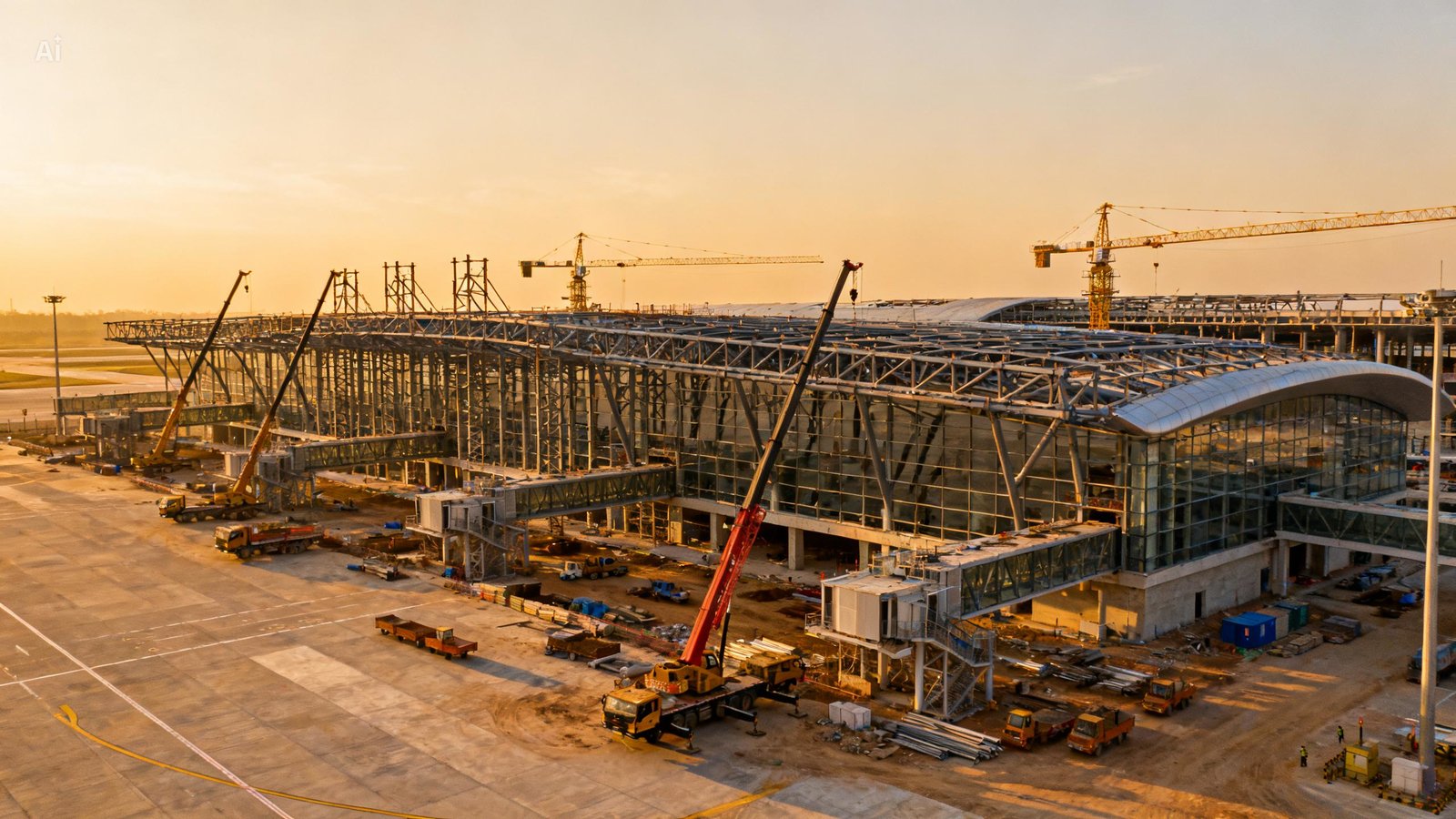
Major airport capital programs — terminal expansions, airside developments, runway reconstructions — run for years with budgets measured in hundreds of millions. A $787M airside development has 65+ concurrent project streams with structural steel, mechanical systems, electrical infrastructure, and architectural finishes advancing simultaneously.
Weekly progress reports from contractors are inherently backward-looking. By the time a deviation appears in a weekly report, two things have happened: the deviation has compounded for 5-7 days, and the contractor's self-reported data may understate the gap. The facility director needs real-time feedback during the “act fast” execution phase that weekly reports cannot provide.
Where This Is Already Deployed
| Project | Scope | Result |
|---|---|---|
| Saudi Arabia airport terminal rehabilitation | 360° capture: 460 sessions, 790K images in 5 months | AI auto-maps video to blueprints for BIM comparison |
| LaGuardia Terminal C, SeaTac IAF | AI construction monitoring (helmet-mounted 360° cameras) | 50% reduction in project delays (3-4 months) |
| SeaTac $968M International Arrivals Facility | 4D digital twin simulation | 3M-pound span placed within 3/8 inch with zero rework |
| Pittsburgh $1.7B Terminal Modernization | Innovation program testing 33 technology firms during construction | Robotic column scanning; model for airport tech adoption |
| Guangzhou Baiyun International | 4D construction modeling | 25% construction efficiency increase |
The Construction-to-Operations Lifecycle Advantage
Dedicated construction monitoring platforms are powerful during the build phase — but they go dark on Day 1 of operations. Sensfix monitors construction progress during the build, then seamlessly transitions to facility maintenance monitoring once the building opens. The same ServiceScanAI that tracked steel erection milestones now detects concrete deterioration. The same ComplainAI that flagged construction defects now routes tenant maintenance requests.
On a $787M project, even a 0.1% reduction in rework saves $787K. But the real value is a platform investment that serves the airport for the full lifecycle of the building — not just the construction phase.
Runway & Airfield FOD Detection and Pavement Inspection
The Problem
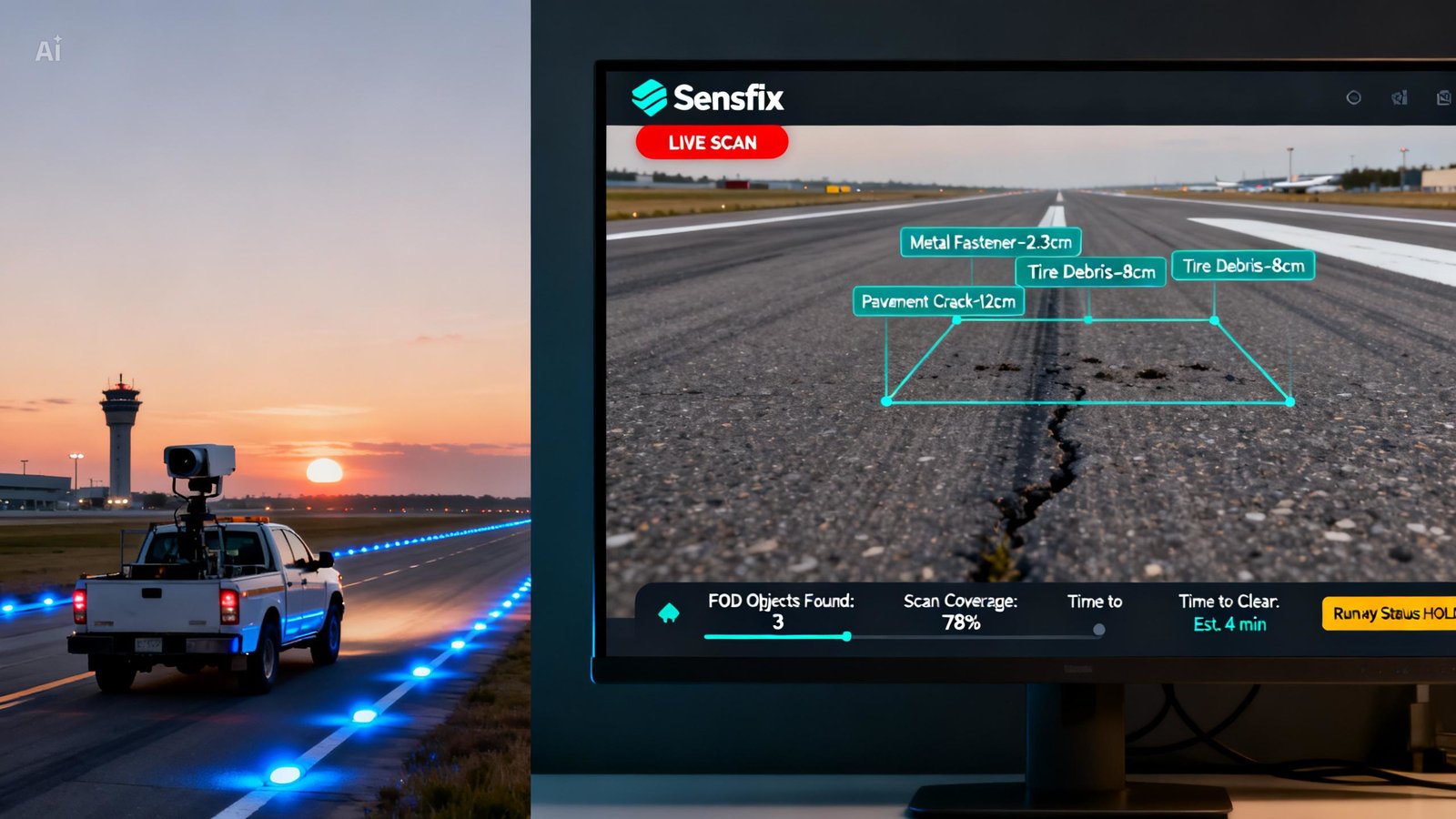
Foreign Object Debris — metal fasteners, tire fragments, pavement chunks, tools, luggage parts — costs the global aviation industry $13 billion annually in damage. The most catastrophic example: a single metal strip on the runway caused the Air France Concorde crash in 2000, killing 113 people.
FAA regulations require regular airfield inspections, but the time available to inspect runways between flight operations is measured in minutes. Manual walkthroughs by trained personnel driving slowly along the runway surface can spot large objects but miss the 2cm bolt or rubber fragment that gets ingested by a jet engine.
Beyond debris, runway pavement itself deteriorates — cracking, rutting, raveling, and surface oxidation progress between formal engineering assessments. A $17M+ runway rehabilitation program needs continuous pavement condition data to prioritize work and validate outcomes.
What Peer Airports Have Achieved
| Airport | Scope | Result |
|---|---|---|
| Boston Logan (first US deployment, 2013) | 68 surface detection units scanning 7,000-ft runway | Full scan in <60 seconds; FAA B/C ratio 1.22-2.44; $2.1-$13.6M NPV over 12 years |
| London Heathrow (since 2007) | Radar-based FOD detection (1,000-1,440 sweeps/day) | Zero FOD damage reported over 100,000+ operational hours |
| Singapore Changi (since 2009) | Vision-based FOD detection system | 95%+ detection in all weather including darkness; false alarms reduced 10x |
| Seattle-Tacoma | 101 surface detection units ($4.6M) | Detects objects as small as aircraft rivets between every movement |
How Sensfix Complements Dedicated FOD Systems
Embedded runway FOD systems are purpose-built hardware installations costing $1.7M-$4.6M per runway. They excel at what they do — and airports may choose to deploy one for their busiest runways. Sensfix complements these systems by providing vehicle-mounted camera-based pavement condition monitoring during routine operations sweeps.
The same vehicle that drives the runway for daily inspection carries a camera feeding ServiceScanAI, which detects cracking, rutting, raveling, and surface deterioration — informing multi-million-dollar runway rehabilitation planning with continuous condition data rather than periodic engineering snapshots. One system finds debris in real time; the other tracks pavement health over time.
Vancouver's detection system paid for itself when it found a single cable that would have caused engine damage. The economics of FOD prevention are asymmetric — the cost of missing one object can exceed the cost of the entire detection system.
AI-Enhanced Security & Perimeter Monitoring
The Problem
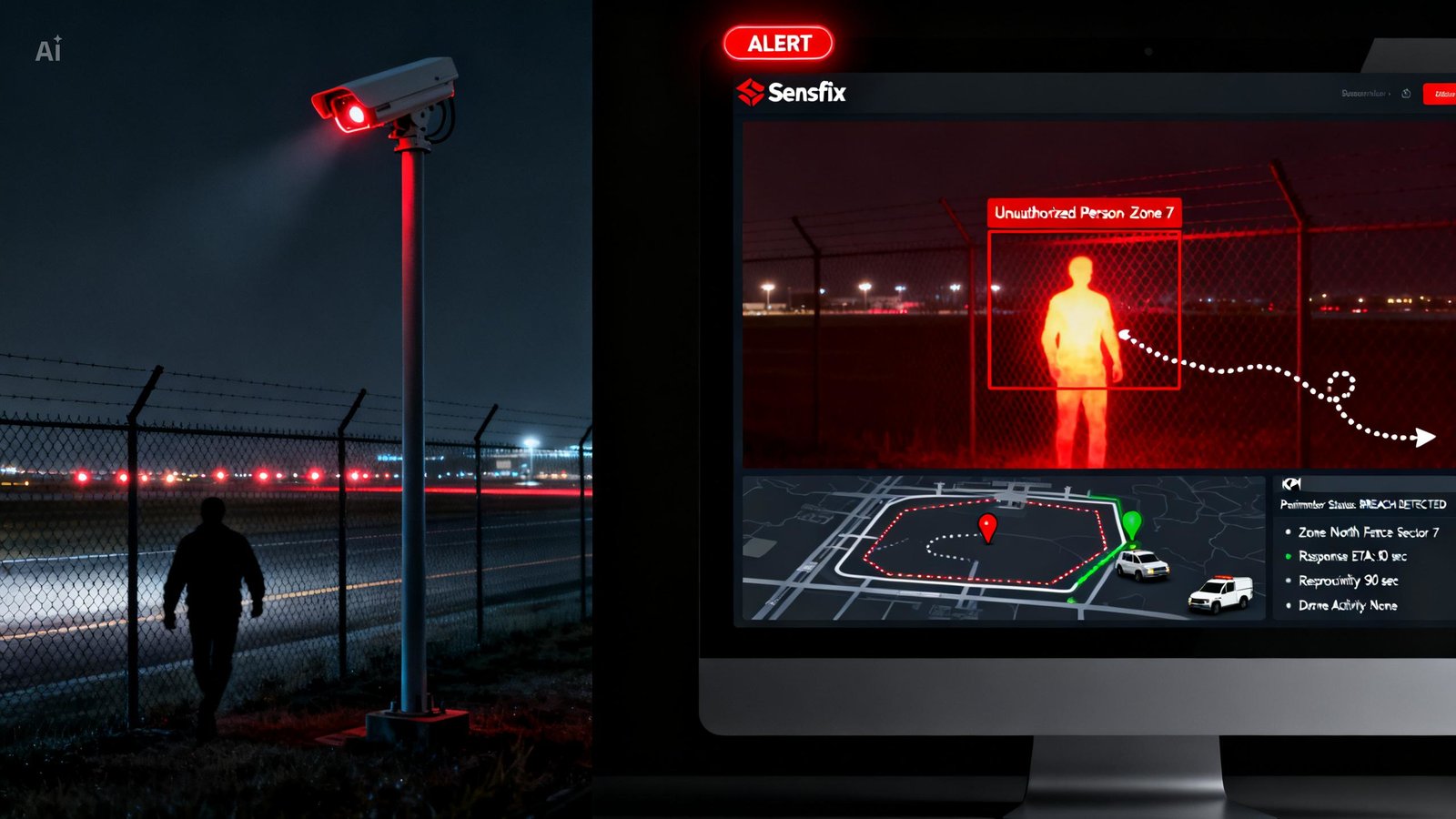
Over 1,300 perimeter breaches were reported at US airports in a single decade. Airport perimeters stretch for miles — chain-link fencing, access gates, service roads, and remote areas that manned guard posts and periodic patrols cannot cover continuously. An unauthorized person breaching the fence and reaching the runway is both a safety catastrophe and a security failure.
Traditional security relies on camera footage reviewed after incidents — a reactive approach that detects breaches after the fact, not in real time. Human operators monitoring multiple video screens experience attention fatigue within 20 minutes, causing critical events to go undetected.
Real-World Security Deployments
| Airport | Scope | Result |
|---|---|---|
| London Heathrow | Unified AI video analytics: 9,000 cameras, 150K+ vehicles/day | Usage split: 50% security, 50% operational efficiency |
| Istanbul Grand Airport (76M sqm) | Multifocal AI camera sensors | Aircraft tracked from landing to departure with fewer cameras than conventional |
| London Heathrow (6+ years) | Multi-sensor AI fusion (radar + RF + video) | Auto-cueing cameras toward threats; filtering benign activity |
How AI Overlays Transform Existing Camera Investments
Many airports invest millions in new perimeter fences with cameras and access control — then treat the cameras as passive recording devices. Sensfix's Multimodal Rule Engine deploys as an AI overlay on freshly installed cameras, adding intrusion detection, unauthorized vehicle alerting, and behavioral anomaly monitoring without any additional hardware.
The rule engine distinguishes between threats and benign activity — wildlife moving near the fence at 3 AM triggers a different response than a person approaching with cutting tools. Zone-based rules adapt automatically: different access permissions during active loading operations versus idle periods, adjusted based on vessel or flight schedules.
Heathrow's IT Product Owner for physical security noted they're "essentially running a small city operation." The same cameras serve both security and operations — and Sensfix enables both from a single platform.
Emergency Generator & Electrical Monitoring
The Problem
The Atlanta Hartsfield-Jackson blackout of December 2017 demonstrated what happens when electrical infrastructure fails without warning: a single switchgear failure disabled both primary and redundant power. 1,100+ flights were cancelled. 30,000 passengers were stranded. The cost exceeded $100 million.
Industry data shows 30% of generators fail to start during actual emergencies. Annual infrared inspections cover less than 1% of operating time. Emergency generators, electrical vaults, and switchgear rooms are critical single points of failure that receive surprisingly little continuous monitoring.
Airports in hurricane-exposed regions face compounding risk. Electrical vaults exposed during storms — as demonstrated during Hurricanes Helene and Milton in 2024 — become immediate operational crises when backup power fails to activate.
A Critical Industry Gap
| Fact | Detail |
|---|---|
| Atlanta blackout cost | $100M+ from a single switchgear failure |
| Generator failure rate | 30% fail to start during actual emergencies |
| Annual IR inspection coverage | Less than 1% of total operating time |
| Hurricane vulnerability | Electrical vaults exposed as single points of failure |
Filling the Gap with Existing Technology
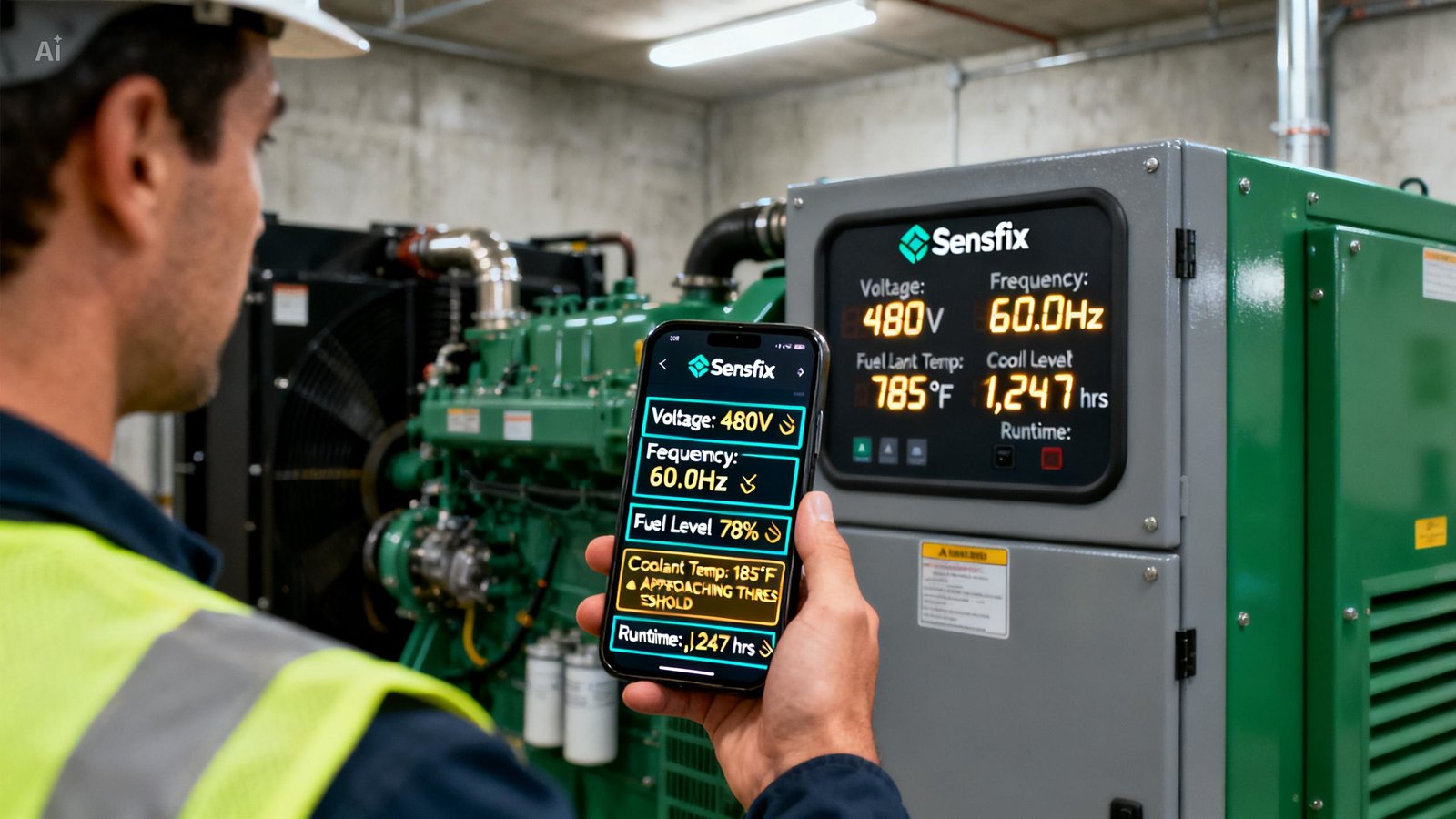
No airport has deployed AI-specific generator monitoring as an integrated system yet — but the component technologies are all production-proven. ServiceOCRPro reads generator panel displays automatically during rounds — voltage, frequency, fuel level, coolant temperature — building a continuous digital record that replaces paper logs and catches slow-declining performance that single-point measurements miss.
ServiceScanAI provides visual monitoring of generator rooms and electrical vaults via existing cameras — detecting water intrusion, overheating indicators, and unauthorized access. TaskflowDigitizerAI ensures storm preparation workflows are executed with mandatory photo verification at every step — so no barrier installation is missed under time pressure.
Pioneering AI-monitored electrical infrastructure at a hurricane-exposed airport would establish a powerful national reference case for aviation resilience.
Roof & Building Envelope Inspection
The Problem
Airport campuses contain vast roof areas — terminal buildings, parking structures, maintenance hangars, utility buildings, and ancillary facilities. A major airport campus assessment might identify 60+ distinct roof areas, with two or more requiring immediate remediation.
Post-hurricane rapid assessment is the acute challenge — facilities teams need to triage dozens of roof areas within hours, not days, to prioritize emergency repairs and file insurance claims. But the chronic challenge is equally expensive: gradual membrane deterioration, ponding water accumulation, and flashing separation that progress undetected between annual assessments, eventually causing interior damage and operational disruption.
FAA airspace restrictions around airports create barriers to drone operations that don't exist for commercial or industrial buildings. Most airport roof inspection must be conducted from ground level or using pole-mounted cameras — not the autonomous drones that other industries rely on.
What Adjacent Industries Show
| Capability | Current State |
|---|---|
| AI drone roof inspection | Processes scans in ~10 minutes; detects water staining, ponding, rust |
| Aerial infrared thermography | Surveys millions of sq ft using FLIR cameras per ASTM C1153 |
| Fixed-wing aerial IR | Scans large facilities in 15-20 minutes vs. days by drone |
| 5G-controlled inspection robots | Trialed at Norwegian airports for landing lights, cracks, and fence inspection |
Sensfix's Ground-Level Approach
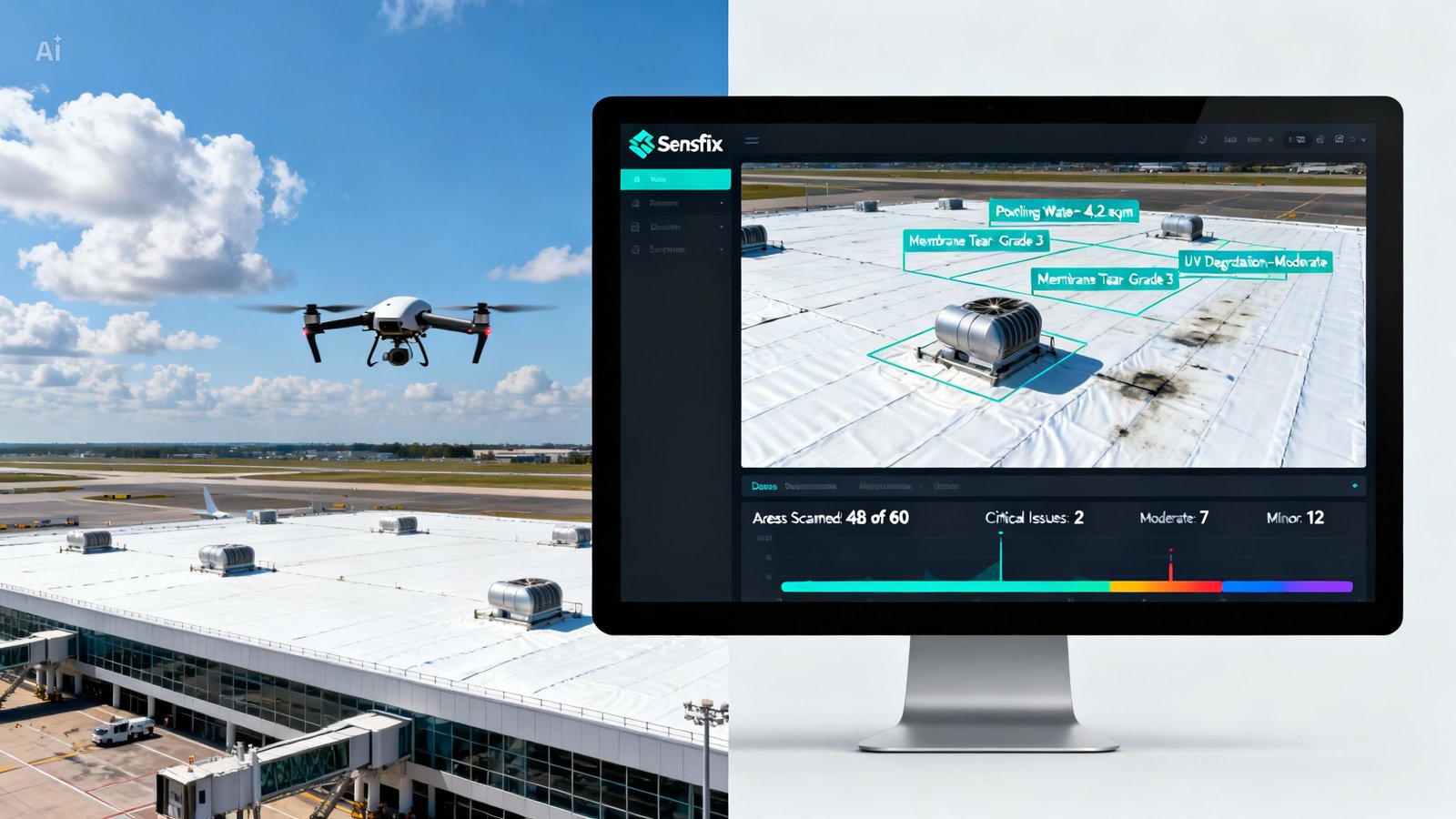
Sensfix's approach uses handheld and pole-mounted cameras operated by ground-level technicians — no drone permits, no airspace coordination, no pilot certification required. For post-hurricane rapid assessment, teams deploy with the Sensfix mobile app, scan each roof area, and AI classifies damage severity instantly. Results flow to the facility manager dashboard in real time.
ServiceScanAI analyzes imagery for membrane deterioration, ponding evidence, flashing separation, and storm damage — the same defect detection models that identify concrete cracking on parking structures and corrosion on industrial equipment. TaskflowDigitizerAI provides post-hurricane rapid assessment workflows with mandatory photo evidence at each location.
What previously took days of manual triage across 60+ roof areas is compressed to hours with coordinated AI-assisted mobile teams. No airport has published a formal AI roof inspection case study — the first-mover opportunity remains open.
Maintenance Workflow Digitization
The Problem
Every system installed at an airport — automatic doors, switchgear, public safety sensors, escalators, jet bridges, HVAC units — comes with manufacturer maintenance procedures that must be executed and documented. Today these procedures are paper-based or scattered across different vendor portals. A technician completing an annual switchgear test may reference a paper manual, record results on a clipboard form, and file the paperwork in a cabinet. If the same switchgear was tested by a different technician last year, there's no easy way to compare results.
The industry benchmark from JLL: average time to receive, classify, and dispatch a maintenance issue is 21 minutes. With paper-based workflows, the cycle time from issue identification to technician dispatch to work completion to supervisor verification to filing can stretch across hours or days.
Industry Performance Data
| Benchmark | Metric | Source |
|---|---|---|
| Issue classification time (manual) | 21 minutes average | JLL industry benchmark |
| Issue classification time (AI-assisted) | Seconds | Sensfix ComplainAI — proven across 3 continents |
| Technician time savings (digital inspection) | 33 hours/month per technician | Industry AI inspection platforms |
| Report generation reduction | 15-20 minutes per report eliminated | Industry AI inspection platforms |
| Spare parts overuse reduction | 80% | Bay Area automaker deployment |
From Paper to Digital in One Platform
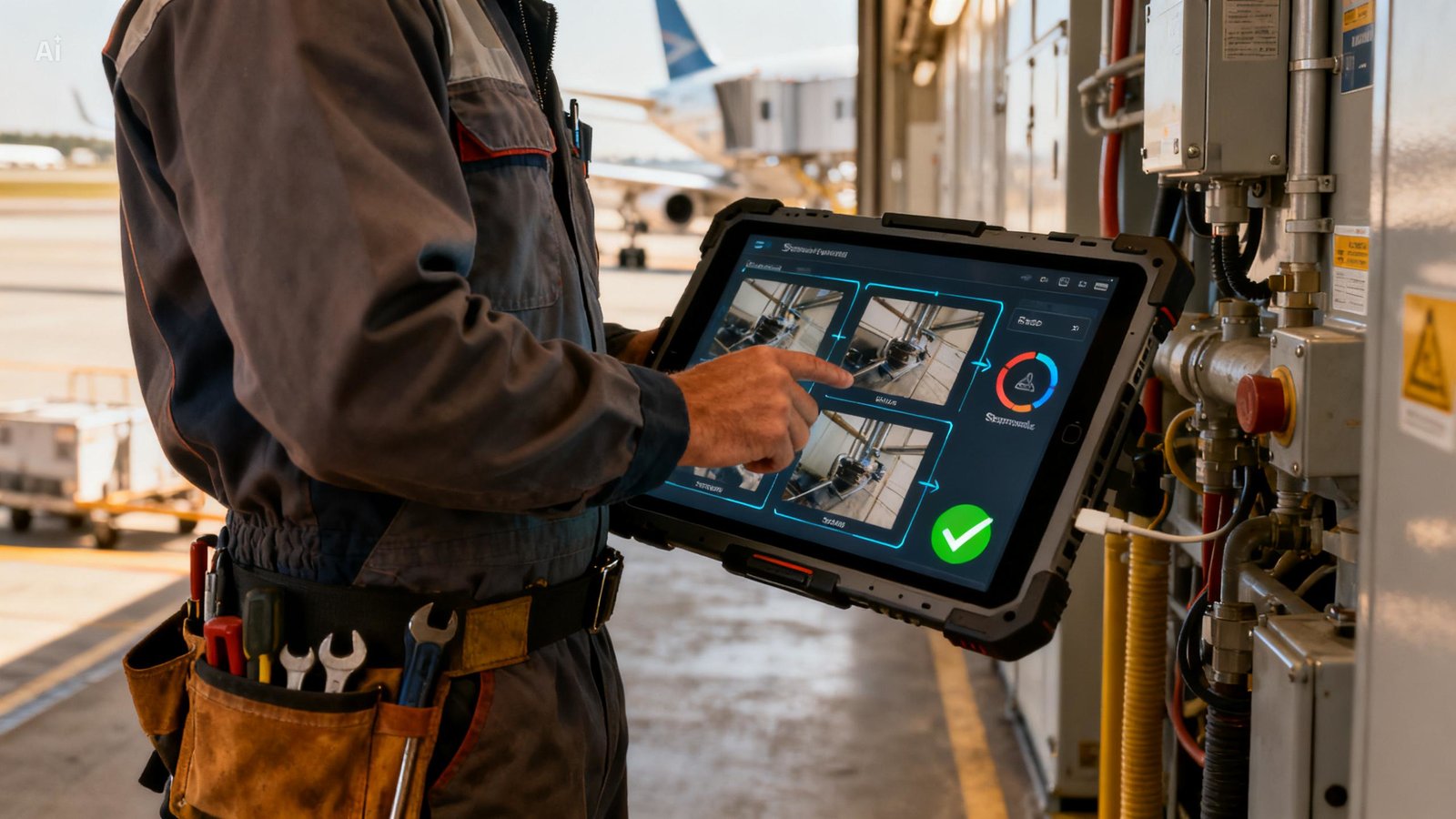
TaskflowDigitizerAI converts any manufacturer maintenance procedure — from automatic door inspection to switchgear testing to jet bridge maintenance — into a digital step-by-step workflow. Technicians swipe through steps on a tablet, capture photo/video evidence at each stage, and facility managers monitor completion in real time.
The critical differentiator is inventory tracking per workflow step. When a technician reaches a step requiring a spare part, the system records what was consumed, by whom, on which asset, at which step. At a Bay Area automaker facility, this per-step tracking reduced spare parts overuse and loss by 80%.
ComplainAI eliminates the 21-minute classification bottleneck entirely. A staff member scans an issue with their phone — the AI classifies, creates a ticket, and routes to the correct team in seconds. No training required beyond knowing how to use a smartphone camera.
Passenger Flow Analytics
The Problem
Human operators monitoring multiple security camera screens experience attention fatigue within 20 minutes. A security checkpoint queue that grows from manageable to overflowing can go unnoticed until passengers start missing flights. Gate areas that exceed safe occupancy during irregular operations create crowd crush risks that manual observation cannot track across an entire terminal simultaneously.
The cumulative wait time in airport queues globally is estimated at 37 billion hours. Every minute a passenger waits in an unnecessary queue is a minute they're not spending in concessions — where airports generate significant non-aeronautical revenue.
How Leading Airports Address This
| Airport/System | Scope | Result |
|---|---|---|
| 120+ airports (Xovis) | 3D stereo vision sensors at checkpoints and gates | 98% passenger tracking accuracy |
| Frankfurt Airport | AeroCloud AI on existing CCTV infrastructure | 50% reduction in check-in times |
| Dallas Fort Worth | Outsight LiDAR large-scale deployment | Real-time passenger journey tracking curb-to-gate |
| Philadelphia International | Live wait-time sensors at security lanes | Real-time display for passengers; staff react faster |
| Global market | Queue detection systems | $1.42B market in 2024, growing at 9.3% CAGR |
How Sensfix Delivers This from Existing Cameras
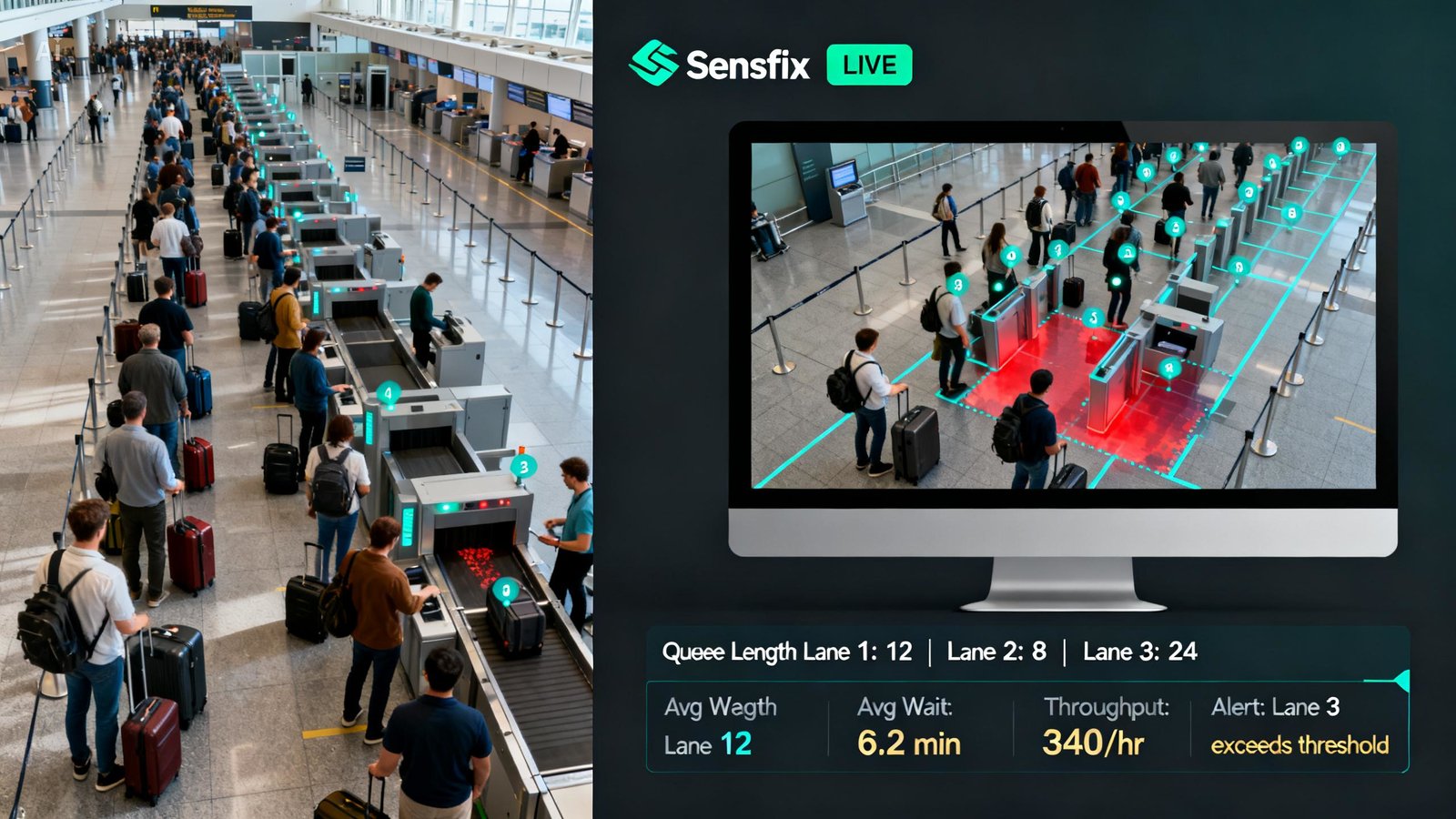
Most passenger flow systems require dedicated hardware — 3D stereo sensors, LiDAR arrays, or proprietary counting devices installed at every checkpoint and gate. Sensfix converts existing CCTV cameras into passenger flow sensors using the same multi-object tracking architecture proven at a major US port for vehicle and personnel monitoring.
The system detects individual people, tracks movement paths, estimates queue lengths, calculates wait times from walking speed and density, and triggers alerts when zone occupancy exceeds thresholds — all from camera feeds the airport already has. The Multimodal Rule Engine enables automated responses: "If security lane 3 queue exceeds 40 people, alert checkpoint supervisor and recommend opening lane 5."
The same tracking capability that counts crane cycles with <1% error at a port terminal counts people with comparable precision at an airport terminal. The difference is the rule set applied to the detections, not the underlying technology.
Aircraft Exterior Inspection
The Problem
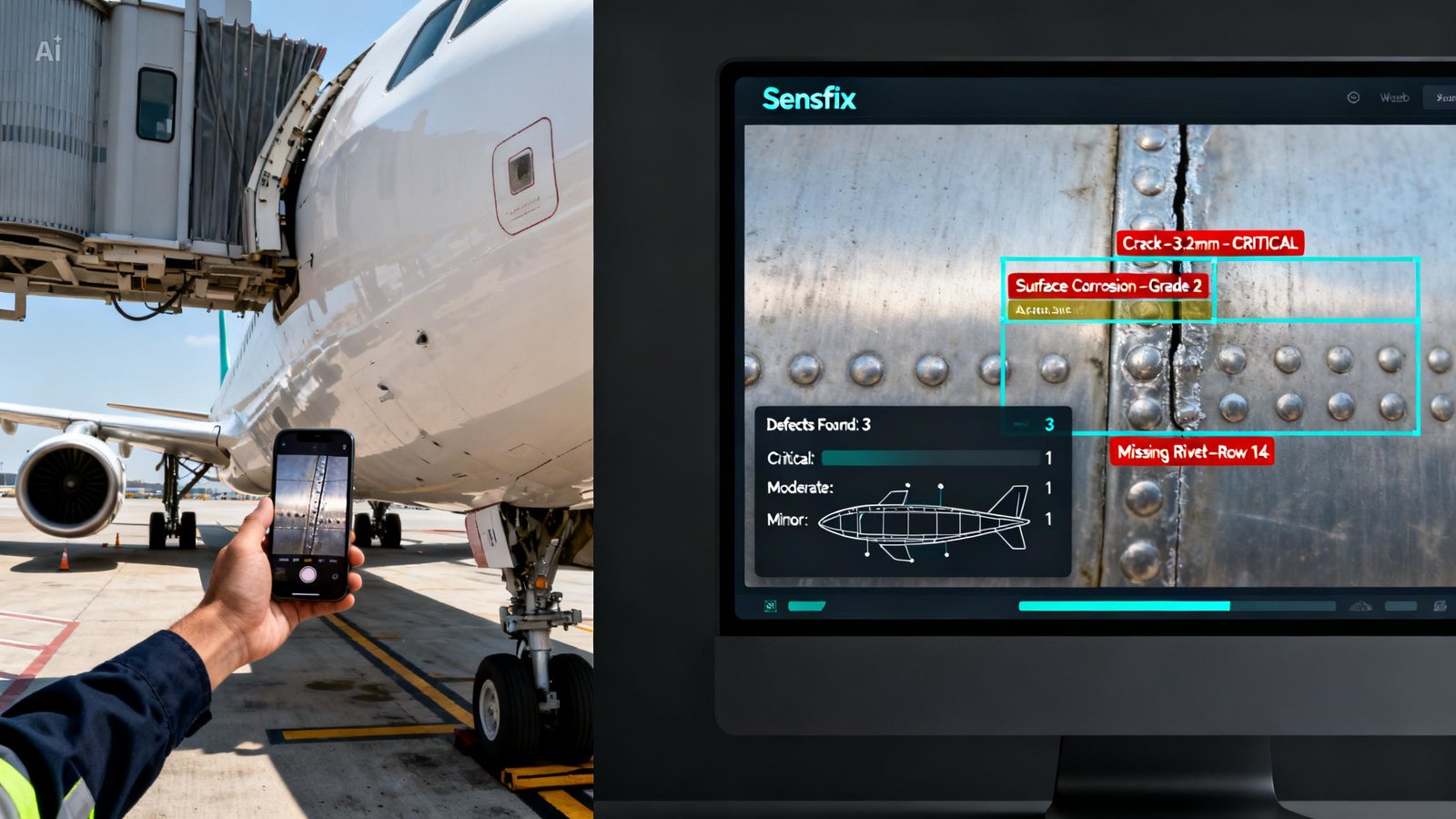
Aircraft exterior inspection has been a manual craft for decades. Certified technicians walk fuselages with flashlights and magnifying glasses, scanning thousands of square feet for cracks, corrosion, dents, missing rivets, and paint deterioration. It is skilled, essential work — but it has inherent constraints that no amount of training overcomes.
Human inspectors experience fatigue. Lighting conditions vary. Different inspectors assess the same defect differently. A hairline crack on the upper fuselage — 15 feet above ground level — is invisible from a walkthrough but critical for structural integrity. Pre-flight inspections are time-constrained: a narrowbody turnaround allows minutes, not hours, for exterior checks.
The global AI-powered aircraft inspection market is projected to grow from $750 million in 2024 to $2.5 billion by 2034 — driven by the fact that machine vision detects 27% more defects than manual methods while cutting inspection times from hours to minutes.
Proven Deployments in Aviation
| Deployment | Scope | Result |
|---|---|---|
| Airbus "Hangar of the Future" | Drone + AI scanning cross-referenced with digital aircraft models | Full airframe defect mapping and localization |
| Boeing 737 production line | AI-powered OCR + visual inspection | 17+ hours saved per airplane |
| Multiple airlines | CV defect detection systems | 95%+ detection accuracy, <2% false positive rate |
| Drone-based exterior scanning | Narrowbody full fuselage capture | Under 15 minutes vs. 4-16 hours manual |
Sensfix's Cross-Industry Advantage
42+ proprietary defect detection models identify cracks, corrosion, dents, and surface anomalies from standard camera imagery — trained across industrial facilities on 3 continents. Sub-millimeter dimensional measurement is proven on rolling stock brake pads at the world's second-largest train manufacturer. The same computer vision pipeline — detecting surface discontinuities and classifying by severity — applies directly to aircraft fuselage, wing, and landing gear inspection.
The critical difference from aviation-only vendors: Sensfix's defect models aren't trained exclusively on aircraft images (which are scarce and proprietary). They're trained on a vast corpus of industrial surface defects — metal cracks, corrosion patterns, paint deterioration, fastener anomalies — across infrastructure, transportation, and manufacturing. This breadth of training data creates models that generalize better to new surface types and defect morphologies.
Aircraft Interior Inspection
The Problem
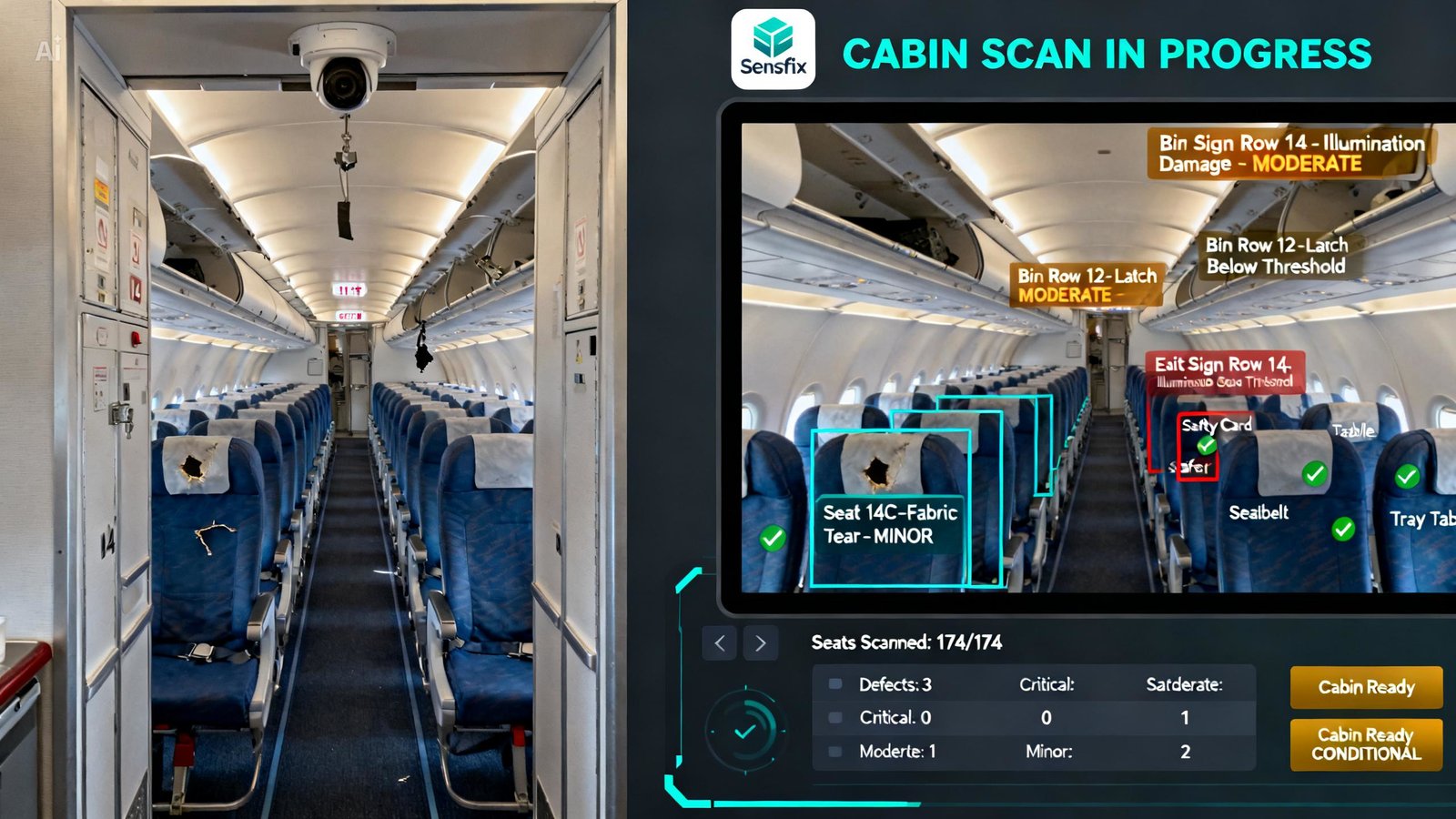
After every flight, cabin crews perform a quick check. After every overnight stay, maintenance teams do a more thorough walkthrough. But “thorough” is relative — a 174-seat aircraft has 174 seats, 87 overhead bins, 24+ exit signs, safety cards in every seat pocket, functioning tray tables, working reading lights, and emergency equipment in designated locations. Checking every element manually is a time-pressure exercise where items get missed.
A torn seat headrest isn't a safety issue — but it's a customer experience failure that accumulates across a fleet. A dim exit sign is a regulatory issue. A missing safety card is a compliance gap that surfaces during audits. The challenge isn't detecting any single defect; it's systematically checking every element across every cabin on every turnaround without human attention fatigue.
A First-Mover Opportunity
No airline has published formal results from AI-powered cabin interior inspection. The technology components exist — computer vision for damage detection, OCR for label verification, illumination measurement for lighting compliance — but no one has assembled them into a production system for aircraft cabins.
The closest proven analogy: at the world's second-largest train manufacturer, automated interior inspection via depot-entry cameras scans seats, labels, displays, cabin illumination, emergency equipment, and safety signage as each train passes through — creating a complete condition report without a human entering the carriage.
How the Train Manufacturer Approach Translates to Aircraft
The architecture is identical: a camera at the entry point (cabin door) captures the full interior as crew or automated systems move through. AI checks every element against the expected condition:
Seat fabric tears, stains, and cushion deterioration classified by severity. Overhead bin latches verified as functional (open/close position detection). Exit signs measured for illumination level against minimum thresholds. Safety cards confirmed present in every seat pocket via pattern recognition. Tray tables verified in stowed position with surface condition assessed. Emergency equipment presence confirmed at designated locations. Overall cabin illumination measured against standards.
The output: a cabin readiness score — PASS, CONDITIONAL (minor issues noted), or FAIL (regulatory items non-compliant) — generated automatically within minutes of the walkthrough.
Ground Support Equipment Tracking

The Problem
A mid-size airport operates hundreds of ground support vehicles — tugs, tractors, belt loaders, cargo loaders, ground power units, de-icing trucks, fuel bowsers, and passenger buses — spread across miles of ramp, taxiway, and apron. Without real-time tracking, dispatchers are flying blind.
A belt loader parked at Gate 14 is invisible to the crew at Gate 27 radioing around trying to find one. A pushback tractor hits 3,000 engine hours with no service record. A fuel bowser idles for 40 minutes between refueling operations, burning diesel. These inefficiencies compound across hundreds of assets and multiple shifts.
Traditional GSE management relies on radio communication and driver memory — “Where's the belt loader?” answered by whoever happens to know. The result: suboptimal fleet utilization, missed maintenance windows, and no data to right-size the fleet.
How the Industry Is Moving
| Technology | Deployment | Result |
|---|---|---|
| GPS fleet tracking (Teltonika) | Airport ground vehicles and equipment | Real-time position of every asset; maintenance triggered by engine hours not calendar |
| AI dashcams (Motive) | GSE fleets | Driver ID, unauthorized use detection, incident reconstruction |
| Telematics + IoT (FleetUp) | Motorized + non-motorized GSE | Every 10 seconds position update; single dashboard for all asset types |
| Autonomous GSE (Royal Schiphol Group) | Planned full automation by 2050 | Autonomous baggage tugs and self-driving pushback tractors |
Extending Sensfix's Proven Asset Tracking
At a 5G-connected manufacturing facility in Poland, Sensfix tracks palettes, forklifts, and expensive tools across the factory floor with GPS location updates, geo-fencing with zone-based alerts, collision detection, and instant notifications when assets leave designated zones. The same IoT + rule engine architecture applies directly to airport GSE fleet management.
The Multimodal Rule Engine adds intelligence that pure GPS tracking doesn't provide: "If pushback tractor has been idle more than 20 minutes AND there are 3 aircraft departures scheduled in the next 45 minutes, alert ramp supervisor." It's not just knowing where equipment is — it's knowing whether it should be there.
De-icing Operations Monitoring

The Problem
Incomplete de-icing coverage on aircraft surfaces is an invisible risk. A wing section that wasn't fully treated can accumulate ice during climb-out, altering aerodynamic performance in ways pilots can't see from the cockpit. De-icing crews work under extreme time pressure — holdover time (the window before anti-icing fluid loses effectiveness) starts counting down the moment fluid is applied.
Manual verification of coverage completeness happens visually from ground level — a crew member looking up at wing surfaces in darkness, snow, and freezing temperatures, trying to confirm that every section received adequate fluid. The conditions under which verification is most critical are precisely the conditions under which human visual assessment is least reliable.
Current Technology Landscape
| Technology | Application | Status |
|---|---|---|
| UAV-mounted multispectral cameras | Pre-de-icing ice detection on aircraft surfaces | EU SEI research project — proven to detect both rime and clear ice |
| AI thermal imaging | Post-de-icing coverage verification | Infrared cameras distinguish treated vs. untreated surface areas |
| Computer vision process monitoring | De-icing fluid application tracking | Zone segmentation with coverage percentage measurement |
| IoT sensors on de-icing vehicles | Fluid volume, pump pressure, nozzle angle | Equipment health and application quality data |
Applying Proven Process Monitoring to De-icing
Computer vision that monitors operational processes in real time and detects deviations from expected patterns is production-proven across Sensfix's industrial deployments on three continents. Monitoring de-icing fluid application coverage on wing surfaces — segmenting zones, measuring coverage percentage, and flagging incomplete areas — uses the same visual analysis pipeline proven for production line quality control and equipment condition assessment.
The Multimodal Rule Engine tracks holdover time from the moment fluid application begins, factoring in ambient temperature and precipitation type to calculate remaining effective time. If coverage falls below threshold before holdover expires, the system alerts the de-icing supervisor with a zone-specific visual showing exactly which area needs retreatment.
Audio AI adds a maintenance dimension — monitoring de-icing vehicle pump and spray system health during operations, detecting pressure drops or nozzle blockages that compromise application quality.
Parking Occupancy & Flow Management
The Problem
Airport parking generates billions in revenue globally — it's one of the largest non-aeronautical revenue sources for most airports. Yet parking management at many airports remains surprisingly analog: loop detectors count vehicles entering and exiting, overhead indicators show red/green availability, and that's the extent of the intelligence.
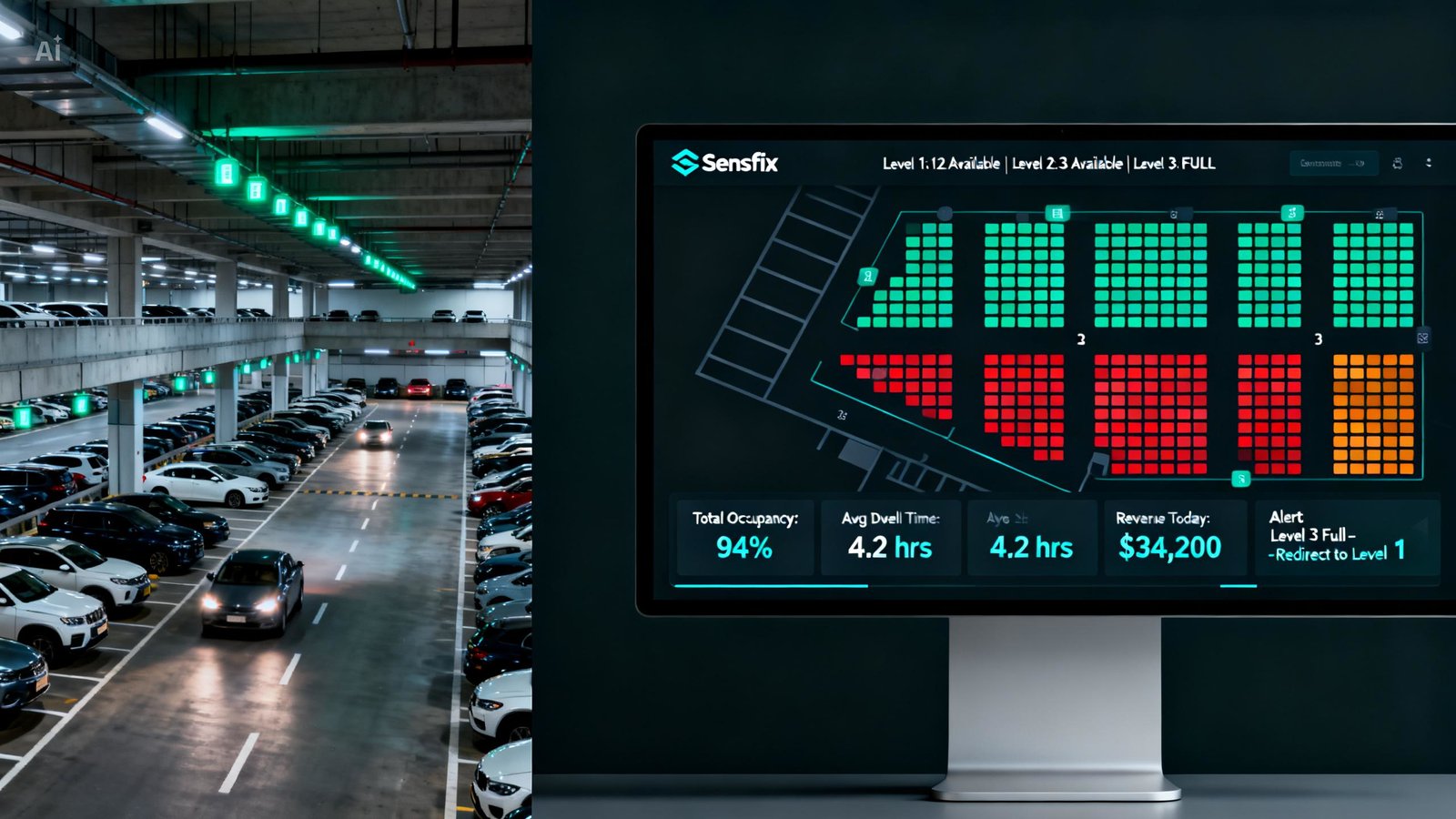
Real-time occupancy data at the floor and zone level — not just the facility level — enables dynamic pricing, targeted overflow routing, and passenger experience improvements that simple entry/exit counting cannot provide. A passenger circling Level 3 looking for a space that doesn't exist wastes their time, creates traffic congestion, increases emissions, and damages the airport's brand.
What the Technology Enables
| Capability | Application | Value |
|---|---|---|
| Computer vision space detection | Individual space occupancy from existing cameras | Accurate availability by zone, level, and proximity to terminal |
| Vehicle flow analytics | Movement patterns, dwell time, peak hour mapping | Data-driven pricing and capacity planning |
| License plate recognition | Automated entry/exit without tickets | Reduced gate processing time, improved throughput |
| Predictive occupancy modeling | Flight schedule + historical patterns | Pre-position overflow routing before capacity is reached |
Sensfix's Camera-First Approach
Real-time monitoring of space occupancy, vehicle movement patterns, and zone-based analytics is a direct application of the same computer vision tracking capabilities proven at a major US port for vehicle counting and flow analysis with <1% error rate. The same AI that counts trucks entering a port facility counts vehicles entering a parking structure.
The Multimodal Rule Engine triggers automated responses when occupancy thresholds are reached — dynamic signage updates, overflow lot activation, and staffing alerts. Predictive models combine flight schedule data with historical occupancy patterns to forecast when each level will reach capacity, enabling proactive routing before passengers experience the frustration of full lots.
Unlike dedicated smart parking systems that require sensor installation in every space ($50-200 per space for thousands of spaces), Sensfix achieves zone-level occupancy monitoring from existing garage cameras — dramatically reducing deployment cost while delivering actionable occupancy intelligence.
Transfer Capability Matrix
Every capability listed below is production-proven. The third column shows how each maps to airport operations domains documented above.
| Capability | Where Proven | Airport Application |
|---|---|---|
| Crane cycle monitoring, <1% error | US Gulf Coast port (production) | Cargo ops baseline; passenger flow tracking |
| 42+ defect detection models | Industrial facilities, 3 continents | Concrete cracks, corrosion, aircraft skin defects |
| Audio AI for machinery health | Train manufacturer (compressors) | HVAC motors, BHS conveyors, elevator systems |
| Vibration predictive maintenance (5KHz) | 5G manufacturing facility | Cooling tower gearboxes, crane drives |
| Automated gauge/meter OCR | Industrial + wastewater facilities | Generator panels, HVAC gauges, fire alarm panels |
| Safety zone enforcement | US Gulf Coast port (production) | PPE detection, exclusion zones, perimeter security |
| Multi-site compliance dashboards | European retail chain | Multi-terminal operations reporting |
| Digital workflows + 80% parts savings | Bay Area automaker | Maintenance SOPs, storm prep checklists |
| Train interior automated scanning | World's 2nd-largest train manufacturer | Aircraft cabin inspection |
| Sub-mm brake pad measurement | Train manufacturer (production) | Wheel tread profiles, component dimensional checks |
| Real-time asset tracking + geo-fencing | 5G manufacturing facility | Ground support equipment fleet management |
| Process monitoring + coverage verification | Industrial quality control (3 continents) | De-icing fluid application monitoring |
Implementation Approach
Phase 1: Guided Evaluation (Up to 90 Days)
A structured evaluation where Sensfix deploys the SAAI Suite on two selected use cases under a dedicated services agreement. This phase includes full platform deployment, AI model configuration for airport-specific conditions, and comprehensive reporting — ensuring the airport can evaluate real-world performance with rigor before committing to enterprise-wide deployment.
Pilot A: Parking Garage Structural Monitoring
Deploy computer vision on handheld devices during scheduled inspections. AI detects and classifies concrete defects from photos captured during normal rounds. Deliverable: comparative report — AI findings vs. current manual assessment.
Pilot B: Fire Alarm Inspection Digitization
Digitize the NFPA 72 workflow for one airside. Technicians use TaskflowDigitizerAI with photo evidence at each step. Deliverable: digital inspection record demonstrating audit-readiness, time savings, and deficiency tracking.
Phase 2: Enterprise SaaS Deployment
Following successful evaluation, Sensfix deploys as an enterprise-wide SaaS platform under an annual agreement covering the entire airport campus. Unlimited users, unlimited licenses, unlimited data nodes. Every facility manager, maintenance technician, and contractor. Every camera, sensor, and mobile device. No per-user fees, no data caps. One annual platform fee designed so adoption spreads organically without procurement friction.
About Sensfix
Founded
2018 (Delaware C-Corp)
Headquarters
San Francisco, CA
CEO
Balaji Renukumar
Global Offices
San Francisco · St. Petersburg FL · Łódź Poland · Seoul South Korea
Enterprise Clients
46 clients across 3 continents
EU R&D Grant
€2.5M (2022) — world's first multimodal rule engine
Research
Stanford University — Department of Computer Science, Robotics Laboratory
Technology Partners
Google Cloud · Microsoft Azure
Key Deployments
World's 2nd-largest train manufacturer · Major European infrastructure group · Port of Tampa / Agunsa · South Korean railways · European retail chain · Bay Area automaker