Extending the Multimodal Stack Beyond Vision
Since its inception, the Sensfix SAAI Suite has been built on a foundational premise: that industrial operations generate multiple forms of data, and the most effective AI platform is one that can process, correlate, and act on all of them. Computer vision was the first modality — and remains the most widely deployed — with over 42 proprietary defect detection models spanning six industrial verticals. IoT sensor integration followed, connecting temperature, vibration, pressure, and flow data streams to the platform's multimodal rule engine.
With the release of SAAI Suite 3.0, Sensfix introduces the third major modality: audio AI. This is not an incremental feature addition. It is a fundamental expansion of the platform's perceptual capabilities, enabling the SAAI Suite to hear what cameras cannot see and sensors may not detect — acoustic signatures that reveal the health of mechanical systems, the presence of leaks, and the operational state of equipment across industrial environments.
What Audio AI Enables
Sound carries information that no other sensing modality captures. A compressor developing a bearing fault produces a distinctive acoustic signature weeks before the bearing fails catastrophically. A pressurized pipe with a subsurface leak emits a sound pattern that differs measurably from a sound pipe. A vibrating motor mount generates frequencies that correlate precisely with the type and severity of the mechanical looseness causing the vibration.
SAAI Suite 3.0 introduces audio AI capabilities across three primary application domains:
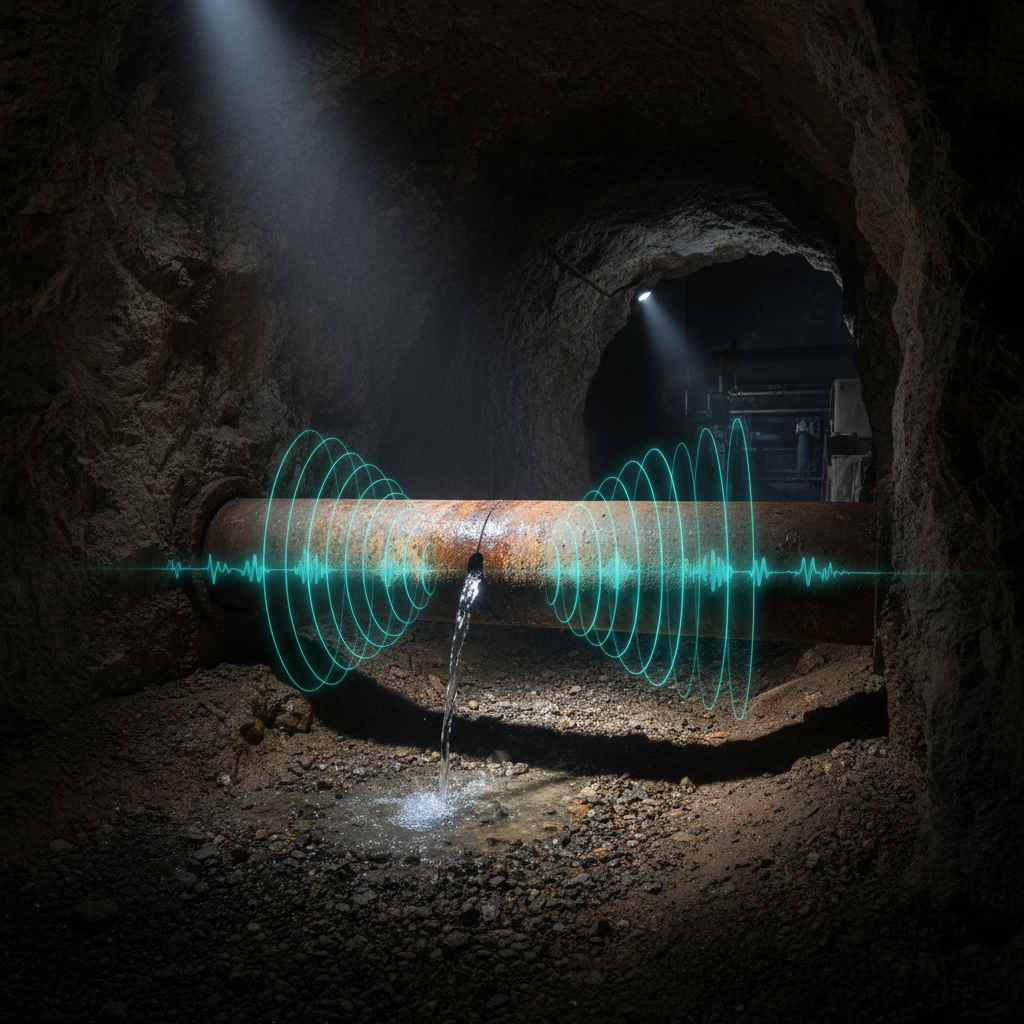
Acoustic Leak Detection: Continuous monitoring of pressurized systems — water distribution networks, compressed air systems, gas pipelines, and hydraulic circuits — for the acoustic signatures of leaks. The models are trained to distinguish leak sounds from environmental noise (traffic, machinery, weather) and to classify leaks by estimated severity and proximity. In water distribution applications, the system achieves sub-meter localization accuracy, enabling repair crews to excavate at precisely the right location rather than conducting exploratory digs.
Compressor and Rotating Equipment Monitoring: Audio models analyze the operating sounds of compressors, pumps, fans, motors, and other rotating machinery to detect anomalies that indicate developing mechanical problems. Bearing wear, valve degradation, imbalance, misalignment, and lubrication deficiency each produce distinctive acoustic patterns that the models classify with high confidence. The system provides early warning of mechanical failure weeks or months in advance, enabling planned maintenance interventions that avoid unplanned downtime.
Vibration Analysis via Audio Proxy: While dedicated vibration sensors provide the highest-fidelity vibration data, audio AI offers a practical alternative for environments where vibration sensors are difficult or expensive to deploy. By analyzing the audio emissions of vibrating equipment, the system can detect and classify vibration-related anomalies — loose mounting hardware, structural resonance, bearing defects — without physical contact with the equipment. This dramatically expands the number of assets that can be monitored without proportionally expanding sensor investment.
Acoustic Leak Detection
Continuous monitoring of pressurized water, compressed air, gas, and hydraulic systems with sub-meter localization accuracy.
Compressor & Rotating Equipment
Early-warning detection of bearing wear, valve degradation, imbalance, and lubrication deficiency weeks before failure.
Vibration Analysis via Audio
Non-contact vibration monitoring that detects loose hardware, resonance, and bearing defects without dedicated sensors.
The Unified Inference Pipeline
Adding a new modality to an AI platform is straightforward if it operates in isolation. The engineering challenge — and the source of genuine competitive advantage — is integrating that modality into a unified inference pipeline where signals from vision, audio, and IoT are correlated in real time to produce decisions that no single modality could support.
SAAI Suite 3.0 achieves this through the mmAI rule engine, which now operates across three modalities simultaneously. Consider a practical example from rail fleet maintenance:
- A computer vision model inspects a train compressor housing and finds no external defects — the visual assessment is healthy
- An audio AI model analyzing the compressor's operating sound detects a subtle frequency shift consistent with early-stage bearing wear — the acoustic assessment is anomalous
- An IoT vibration sensor on the compressor mounting registers a marginal increase in vibration amplitude — the sensor assessment is trending
A single-modality system would either miss the problem entirely (vision-only) or generate an ambiguous alert (audio-only or sensor-only). The mmAI rule engine correlates all three signals, weighs the confidence scores from each modality, and produces a composite assessment: bearing degradation detected with high confidence, recommend scheduled maintenance within 14 days. This cross-modal correlation reduces false positives, catches true positives earlier, and provides maintenance planners with the contextual intelligence they need to make informed decisions.
The value of multimodal AI is not additive — it is multiplicative. Each additional modality does not simply add one more data point. It validates, contextualizes, and disambiguates the signals from every other modality. That is the fundamental insight behind the unified inference pipeline.
Production Validation: Trains and Water
SAAI Suite 3.0's audio AI capabilities are not launching from the laboratory. They have been validated in production environments across two demanding industrial domains.
In rail fleet maintenance, audio AI for compressor health monitoring has been deployed with Alstom across European maintenance depots. The system operates alongside nine computer vision defect detection models, providing a comprehensive multimodal inspection capability that covers both external visual defects and internal mechanical health. The audio models have successfully identified compressor bearing degradation, valve anomalies, and refrigerant cycle irregularities that visual inspection alone could not detect.
In water infrastructure, acoustic leak detection models have been validated in pipeline monitoring applications, building on a 17-week proof of concept with Cadagua (part of the Ferrovial group). The models demonstrated the ability to detect and localize leaks in pressurized pipe systems, distinguishing leak signatures from the complex acoustic environment of underground utility corridors. The results confirmed that audio AI can extend the SAAI Suite's operational value into infrastructure domains where computer vision has limited applicability.
42+ Defect Models and Growing
With the addition of audio AI, the SAAI Suite's model library continues to expand. The platform now offers over 42 proprietary detection models spanning visual and acoustic modalities:
- Visual defect detection: Cracks, corrosion, surface damage, equipment faults, wear indicators, contamination, structural deformation, and vandalism across rail, port, manufacturing, utility, retail, and facility environments
- Acoustic anomaly detection: Bearing wear, valve degradation, leak signatures, compressor health, motor imbalance, and vibration-related defects
- Cross-modal detection: Compound conditions that require evidence from multiple modalities to classify accurately
Each model is trained on real-world industrial data collected during production deployments — not on synthetic datasets or laboratory samples. This production-origin training data is critical for accuracy in the noisy, variable, and unpredictable conditions of actual industrial environments.
Edge Processing Improvements
Audio AI introduces new processing requirements that SAAI Suite 3.0 addresses through significant improvements to edge computing capabilities. Audio streams are continuous and latency-sensitive — a leak detection system that takes minutes to process a few seconds of audio is not operationally useful. The platform's edge processing layer has been optimized to run audio inference models alongside vision models on the same edge hardware, without degrading the performance of either modality.
Key edge improvements in SAAI Suite 3.0 include:
- Concurrent multimodal inference: Vision and audio models execute simultaneously on shared edge compute resources, with intelligent scheduling that prioritizes time-critical detections
- Optimized audio preprocessing: Spectral analysis, noise filtering, and feature extraction are performed at the edge, reducing the data volume that needs to be transmitted to cloud infrastructure
- Adaptive sampling: The system adjusts audio sampling rates based on environmental conditions and detection confidence, conserving compute and bandwidth during quiet periods while increasing resolution when anomalies are detected
- Model versioning at the edge: Updated audio and vision models can be deployed to edge devices without service interruption, ensuring that the latest detection capabilities are always available
Single-License Platform Model
One of the most significant aspects of the SAAI Suite 3.0 release is what it does not require: a separate license for audio AI. The platform's licensing model provides access to all modalities — vision, audio, IoT integration, OCR, and workflow automation — under a single platform license. Organizations that are already deploying the SAAI Suite for computer vision can activate audio AI capabilities without a new procurement cycle, a new vendor relationship, or a new integration project.
This stands in contrast to the fragmented approach that characterizes much of the industrial AI market, where each modality and each application requires a separate vendor, a separate contract, and a separate integration effort. The cumulative cost and complexity of assembling five or six point solutions — and the absence of cross-modal intelligence between them — is precisely the problem that the unified platform model was designed to solve.
Single-License Platform Model
SAAI Suite 3.0 represents the realization of a vision that has guided Sensfix's product development from the beginning: a single platform that sees, hears, senses, reads, and acts across the full complexity of industrial operations. With audio AI now in production, that vision is no longer aspirational. It is deployed, validated, and available.
Ready to See These Results?
Book a personalized demo and see how the SAAI Suite delivers measurable outcomes for your operations.